
ADHD, time blindness, and the executive functions behind where the day went.
You sit down at 9:00 in the morning to answer one email.
Before you know it, you have checked the weather, researched a restaurant you might visit three months from now, reorganized one section of your desk, and watched a video explaining why cats knock things off tables.
Then you glance at the clock. It is 4:30.
You are not entirely sure what happened to the day, but that single email is still sitting there…patiently waiting for a reply.
Sound familiar?
For many people with ADHD, time does not feel like a steady, dependable stream. Five minutes can disappear instantly. A thirty-minute task can feel as though it will take the entire day. “I’ll do it later” can quietly become “Why is this due tomorrow?”
This experience is known as time blindness.
What Is Time Blindness?
Time blindness is not a formal medical diagnosis. It is an informal term used to describe difficulty noticing, estimating, and responding to the passage of time.
Research suggests that some children and adults with ADHD have differences in time estimation, time reproduction, and other forms of temporal processing. However, ADHD affects people differently, and not everyone experiences time in exactly the same way.
In daily life, time blindness often looks like:
- Underestimating how long a task will take.
- Losing track of time entirely during an interesting activity.
- Feeling blindsided by approaching deadlines.
- Struggling to plan backward from an appointment.
- Chronically arriving late — or being anxiously early because you are afraid of being late.
- Believing you have “plenty of time” until you suddenly have none.
Crucial note: This is not a matter of not caring. A person can care deeply about a meeting, assignment, family commitment, or deadline and still have difficulty organizing their behavior around time.
Why Can Time Feel So Slippery With ADHD?
Managing time is not just one single skill. It is a complex process that depends on several executive functions working together in harmony:
- Attention: To track time, you must remain aware of your surroundings. When attention becomes completely absorbed in an activity, other information — including the clock — fades into the background.
- Working Memory: This helps you keep information active while you use it. When you think, “I have to leave at 2:15, but first I need to save this file, grab my keys, and put the package in the car,” you are relying on working memory. If one piece of that mental list drops out, the entire timeline collapses.
- Planning: Arriving at a 3:00 PM appointment requires thinking about travel time, parking, gathering your belongings, and the inevitable five minutes spent looking for your phone.
- Task Initiation: Knowing something needs to be done does not automatically create the ability to begin it. You can watch your available time shrink throughout the day and still feel entirely unable to get started.
- Cognitive Flexibility: Getting somewhere on time requires stopping one activity and switching to another. That transition is incredibly difficult when the current activity is interesting and the next one is tedious.
The ADHD Timeline: “Now” and “Not Now”
Imagine you need to submit a report next Friday. Logically, you know Friday is approaching. Emotionally, however, next Friday belongs in a vague, distant category: Not Now.
- Monday passes. Still Not Now.
- Tuesday passes. Probably still Not Now.
- Thursday evening arrives.
Suddenly, the deadline enters the Now zone. Your nervous system wakes up and announces:
“Good news! We have located the urgency!”
This creates a painful, exhausting cycle. We wait until panic or urgency appears, complete the work under intense pressure, and promise ourselves we will never do it again… until the next deadline.
Over time, this cycle breeds negative self-talk: “I’m lazy.” “I don’t care enough.” “I should be able to do this by now.”
But this does not improve time awareness. In fact, it triggers avoidance and makes it even harder to begin. The goal is not to criticize yourself into becoming a human clock. The goal is to make time visible.
6 Ways to Make Time Visible
Telling yourself to “pay more attention” rarely works. Instead, you need to move time out of your head and into your physical environment.
1. Use a Clock You Can Actually See
A phone technically has a clock, but picking it up to check the time is a trap. You check the hour and suddenly find yourself reading comments under a video about a raccoon stealing a sandwich. Place an analog clock, a digital clock, or a visual timer directly in your workspace so you don’t have to interrupt your workflow to find it.
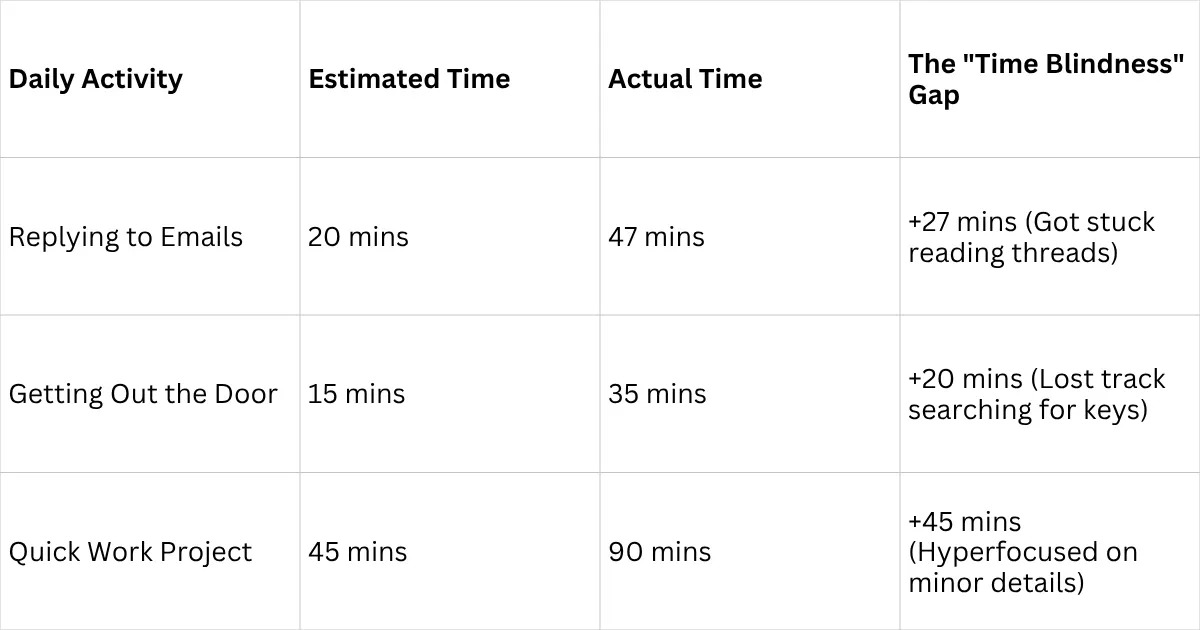
2. Estimate Before You Begin
Before starting a task, write down how long you think it will take, then track the actual time. Do not use the difference to judge yourself; use it as data.
3. Create a Sequence of Alerts
One alarm tells you it is time to leave, but it doesn’t prepare you to leave. Try a sequence instead:
- 30 minutes before: Begin wrapping up.
- 15 minutes before: Save your work and gather your things.
- 5 minutes before: Shoes on, head toward the door.
4. Attach Alarms to Specific Actions
An alarm without a clear directive quickly becomes background noise. Instead of labeling an alarm “Meeting,” label it with the immediate physical action required: “Close the document,” “Open the Zoom link,” or “Put on your shoes.”
5. Build in “Transition Buffers”
Appointments do not begin when you arrive; they begin when you stop your previous activity. Always build a buffer between tasks, especially when travel, technology, or finding clean socks is involved.
6. Break Large Blocks Into Checkpoints
“Work on the project this afternoon” is too vague. Try breaking it down into micro-steps:
- 1:00–1:15: Open files and review instructions.
- 1:15–1:45: Complete the first section.
- 1:45–1:50: Stand up and stretch.
From Tools to Skills: Training the Brain
Timers, calendars, and planners are incredibly useful tools, but owning a planner is not the same as checking it. Setting an alarm is not the same as responding to it.
Because time management is an active executive function rather than a static piece of knowledge, we can actually train our brains to get better at it. This is exactly where cognitive training tools come into play.
How Play Attention Connects Attention to Time
Play Attention uses NASA-inspired neurotechnology and interactive exercises to help children and adults practice the exact executive function skills involved in daily time management:
- Attention Stamina: Helps you practice staying mentally engaged rather than drifting away from the task at hand.
- Time on Task: Builds a real-time awareness of whether your attention is directed toward your goal or a distraction.
- Short-Term Memory: Supports the working memory required to hold instructions, schedules, and next steps in mind.
- Discriminatory Processing: Helps you practice deciding what information deserves your focus and what can be safely ignored.
- Academic/Professional Bridge: Allows you to practice maintaining attention during real-life activities (like homework or office tasks) rather than just inside a training exercise.
The goal isn’t to develop a perfect internal stopwatch. The goal is to become aware of where your attention is going, recognize when it has shifted, and gently bring it back.
Try This Exercise Today
Choose just one activity you regularly underestimate (e.g., getting ready in the morning, answering email, cooking dinner, or getting ready for bed).
- Write down your estimated time.
- Start a timer.
- When you finish, compare the actual result.
Instead of feeling frustrated by a gap, ask yourself: Where did I lose track? Did a specific step take longer than expected? Did I get distracted?
This small exercise turns “Where did the day go?” into useful, actionable information. The day didn’t disappear — it just went somewhere your attention wasn’t tracking. With greater awareness, stronger environment supports, and intentional practice, you can start deciding exactly where your time goes next.
Ready to strengthen the executive function skills behind attention, planning, and follow-through? Learn more about how Play Attention helps children and adults practice the skills they use at school, at work, and throughout daily life.