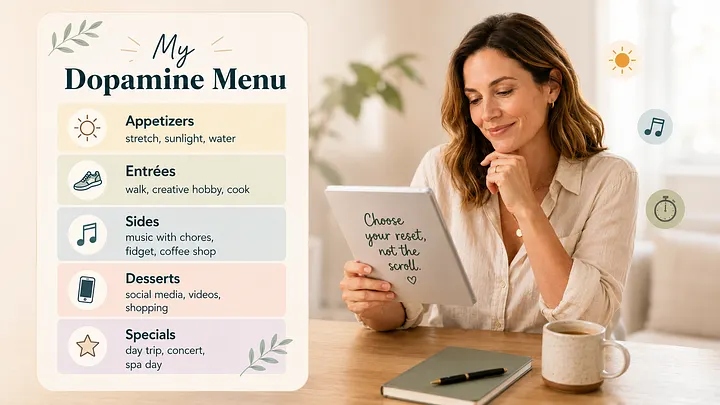
A ready-to-use template to help you stop default doomscrolling and give your brain the stimulation it is actually craving
Have you ever hit an invisible wall in the middle of your workday, realized your brain was completely out of mental energy, and then spent the next two hours doomscrolling social media?
And somehow, instead of feeling better, you ended up feeling more tired, more behind, and more frustrated with yourself?
If you live with ADHD, this cycle may feel painfully familiar.
ADHD is often associated with differences in dopamine regulation, reward, motivation, and executive function. In everyday life, that can make it harder to start tasks, stay with boring work, shift gears, and resist quick sources of stimulation.
So when your mental tank is empty, your brain may start hunting for the fastest and easiest thing that feels rewarding.
That often means social media, impulse shopping, junk food, fast-paced games, or another “just for a minute” activity that somehow turns into an hour.
These activities are not bad in themselves. The problem is that they often provide quick stimulation without true restoration. They may feel good for a few moments, but they can leave you feeling drained, scattered, and guilty.
That is where a Dopamine Menu can help.
What Is a Dopamine Menu?
A Dopamine Menu, sometimes called a “Dopamenu,” is a pre-made list of healthy stimulation options organized like a restaurant menu.
The idea has been popularized in the ADHD community by Eric Tivers, host of the ADHD reWired podcast, and Jessica McCabe of How to ADHD.
The concept is simple: when your brain is foggy, tired, bored, or stuck, you do not want to have to make one more decision.
That is because executive function, the brain’s management system, is already working hard. Executive function helps you plan, make decisions, use working memory, control impulses, and shift from one task to another.
When executive function is tired, even deciding what to do to feel better can feel like too much.
A Dopamine Menu removes that decision friction.
Instead of staring at the wall, opening Instagram without thinking, or wandering into the kitchen for the third time, you can open your menu and “order” something your brain actually needs.
Why a Dopamine Menu Works
A Dopamine Menu works because it gives your brain structure before you need it.
When you are calm and thinking clearly, you make a list of options that help you reset, refocus, or feel more satisfied. Then, when your brain gets stuck, you do not have to invent a solution from scratch.
You simply choose from the menu.
For people with ADHD, this kind of external structure can be very helpful. It turns a vague question like, “What should I do right now?” into a much easier question: “Which option on my menu fits this moment?”
That is where the menu does its job: it catches you before autopilot takes over.
It helps you pause before reacting. It gives you a better choice. And it can help you move from automatic behavior to intentional action.
The 5 Courses of a Dopamine Menu
To make your menu useful when executive dysfunction hits, organize your options into five categories based on time, effort, and context.
1. Appetizers (Quick 2–5 Minute Resets)
Appetizers are fast, low-effort activities that help you break task paralysis or give your brain a quick burst of alertness without completely derailing your day.
These are the options you use when you need a small reset, but you still want to come back to your task.
- Doing 10 jumping jacks or stretching for 2 minutes.
- Stepping outside for direct sunlight on your face.
- Petting your dog or cat for a quick mood lift.
- Drinking a cold glass of ice water.
- Take five slow breaths before restarting your task.
- Blasting one energetic song and having a mini dance party.
The key is to keep appetizers short. They should help you restart, not pull you into an entirely new activity.
2. Entrées (Deep, Fulfilling Activities)
Entrées are longer activities that take 30 to 60 minutes or more. These are not quick fixes. They are activities that nourish your brain and give you a deeper sense of satisfaction.
These are especially helpful when you have been relying too much on low-effort stimulation and need something more meaningful.
- Working on a hands-on creative hobby (drawing, woodworking, crafting).
- Going for a bike ride or hiking a scenic trail.
- Reading a chapter of a book you actually love.
- Cooking a delicious, colorful meal from scratch.
- Attending an exercise class.
Entrées take more planning, but they often leave you feeling much better than quick-scroll activities. They help your brain feel engaged, capable, and satisfied.
3. Sides: Stimulation Pairings
Sides are activities you pair with boring, repetitive, or low-dopamine tasks to make them more bearable.
This is helpful because many ADHD brains struggle when a task is necessary but not interesting. Pairing the task with the right kind of stimulation can make it easier to begin and stay with it.
- Listening to a compelling true-crime podcast while washing dishes.
- Use a walking pad while reviewing notes.
- Working at a lively coffee shop instead of a quiet room.
- Playing a curated lo-fi or video game soundtrack playlist while writing emails.
- Body double with a friend while both of you work on separate tasks.
- Play instrumental music while answering emails.
Sides are not meant to distract you from the task. They are meant to give your brain just enough stimulation to stay with it.
4. Desserts (Proceed with Caution)
Desserts are high-stimulation, low-effort activities. They feel good in the moment, but they can easily take over more time than you intended.
These are not forbidden. In fact, banning them completely can backfire. Deprivation can lead to burnout, frustration, or rebellion.
Instead, treat desserts like actual dessert. Enjoy them intentionally.High-dopamine, low-effort activities that feel great in the moment but can easily eat up your entire afternoon if unmonitored.
- Scrolling TikTok, Instagram Reels, or Reddit.
- Playing fast-paced video games.
- Watch funny videos.
- Binge-watching television series.
- Browsing online storefronts.
The rule for desserts is simple: use a timer.
Not a vague “I will only do this for a little while” promise. Use an actual external timer. A visual timer is even better.
You might say, “I am going to watch TikTok for 15 minutes, and when the timer goes off, I will stop and choose what comes next.”
That one step can help you enjoy the activity without losing the entire afternoon.
5. Specials (Big Rewards & Novelty)
Specials are exciting, occasional experiences that require more time, money, planning, or energy.
These are not everyday options, but they can give your brain something to look forward to. Novelty can be especially motivating for people with ADHD.
- Booking a weekend day trip to a nearby town or park.
- Going to a live concert, theater show, or comedy gig.
- Booking a massage or spa day.
- Organizing an escape room night with friends.
- Visit a museum, botanical garden, or new restaurant.
- Take a class just for fun.
- Plan a “phone-free” adventure day.
Specials give your brain a bigger reward to anticipate. They can also help you build a life that feels more engaging and less dependent on quick digital stimulation.
How to Build Your Own Dopamine Menu
The most important rule is this: keep it simple.
Do not try to create the perfect menu. Do not turn it into a major project. Start with just two or three ideas in each category.
Your menu should be realistic. If you hate running, do not put running on your menu. If you are not going to cook from scratch on a busy Wednesday, do not make that your main option.
Choose activities that actually fit your life
Ask yourself:
What helps me feel more awake?
What helps me feel calmer?
What helps me restart when I am stuck?
What gives me real satisfaction?
What activities do I want to enjoy intentionally instead of automatically?
Once you create your menu, put it somewhere easy to access. Save it in your Notes app. Print it and tape it near your desk. Put it on your fridge. Add it to your planner.
The menu only works if you can find it when your brain needs it.
Copy and Paste Dopamine Menu Template
Use this template in your Notes app, planner, or journal.
📋 MY PERSONAL DOPAMINE MENU
🍟 APPETIZERS
Quick resets, 5 minutes or less[ ] ___________________________________________
[ ] ___________________________________________
[ ] ___________________________________________
[ ] ___________________________________________
🍝 ENTRÉES
Deeper, fulfilling activities, 30 to 60 minutes or more[ ] ___________________________________________
[ ] ___________________________________________
[ ] ___________________________________________
[ ] ___________________________________________
🥗 SIDES
Stimulation pairings for boring tasks[ ] ___________________________________________
[ ] ___________________________________________
[ ] ___________________________________________
[ ] ___________________________________________
🍰 DESSERTS
Enjoy intentionally with a timer[ ] ___________________________________________
[ ] ___________________________________________
[ ] ___________________________________________
✨ SPECIALS
Occasional big rewards and novelty[ ] ___________________________________________
[ ] ___________________________________________
[ ] ___________________________________________
A Dopamine Menu Is a Tool, Not a Cure
A Dopamine Menu can help you create a better plan for the moments when your brain is craving stimulation.
But for many people with ADHD, the bigger challenge is not knowing what to do.
The harder part is being able to pause, shift gears, start the task, stay with it, and follow through long enough to feel successful.
That is where executive function training matters.
How Play Attention Can Help
Play Attention uses NASA-inspired neurotechnology, cognitive skill training, and personalized support to help children, teens, and adults strengthen the executive function skills behind focus, self-regulation, task completion, working memory, and follow-through.
👉Schedule Your Play Attention Consultation
A Dopamine Menu gives you better choices.
Play Attention helps you build the skills to use those choices more consistently.
With Play Attention, you learn how to recognize when your attention is drifting, practice returning to task, strengthen self-control, and build the mental stamina needed for real-life success.
If you or your child often feel stuck in cycles of distraction, procrastination, mental fatigue, or unfinished tasks, we invite you to schedule a Play Attention consultation.
During your consultation, we will talk with you about your goals, help you understand what may be getting in the way, and show you how Play Attention can be customized to support meaningful progress.
Schedule your Play Attention consultation today and take the next step toward stronger focus, better self-regulation, and more confident follow-through.